Clinical information
Ketamine therapy in London: every treatment starts with an assessment
Before you read on
Ketamine treatment isn’t right for everyone, so nobody starts treatment with us without a specialist assessment first. That assessment may or may not end in a recommendation for ketamine.
Infusion Therapy London is a specialist clinic in Fulham, London, for adults whose depression hasn’t improved enough with standard treatment, including people whose depression is tangled up with trauma. Ketamine is one option. At assessment we also look at medication, psychological therapy such as EMDR, and NHS routes, and we recommend whatever is most likely to help you.
Ketamine is licensed in the UK as an anaesthetic. Using it for depression is “off-label”, which we explain further down.
- Confidential
- Reply within 1–2 business days
- No commitment to treatment
Is ketamine treatment right for you?
It might be, but for many people it isn’t, and finding that out is the job of the assessment.
Who it may be considered for
Ketamine has been studied most in treatment-resistant depression: depression that hasn’t improved enough after at least two antidepressants, each taken at a proper dose for long enough.8
There is also research in post-traumatic stress disorder (PTSD), with some encouraging results (see the evidence below). For PTSD itself, NICE recommends trauma-focused psychological therapies such as EMDR and trauma-focused CBT as the first treatment.10 That’s why trauma therapy is part of how we work, not an add-on.
Who it’s usually not suitable for
Ketamine treatment is usually not recommended if you have:12
- a history of psychosis or schizophrenia
- high blood pressure that isn’t well controlled, or significant heart or blood vessel disease, including a previous stroke
- current misuse of alcohol or drugs, especially ketamine
- a pregnancy, or you’re breastfeeding
- severe liver disease
- raised pressure inside the skull
- an overactive thyroid that isn’t controlled
Bipolar disorder needs extra care because of a risk of triggering mania. We check all of these at assessment. If one applies, we’ll explain why and talk you through what may help instead.
If you’re in crisis now: ketamine treatment in a clinic is not a crisis treatment. If you’re having thoughts of ending your life, call 999 or go to A&E, call NHS 111 and choose the mental health option, or call Samaritans free on 116 123. If you tell us, when you contact us or at your assessment, that you’re at immediate risk, we’ll make sure you know where to get urgent help, and we may contact your GP or the emergency services to keep you safe. Treatment doesn’t start until you’re safe to begin.
How the assessment works
Every patient starts here, whether or not ketamine turns out to be the right next step.
- 1
First contact
You get in touch by email or through our enquiry form, and we ask a few brief questions to check an assessment makes sense for you.
- 2
Specialist assessment
With a consultant psychiatrist, and with Richard Denny for EMDR if trauma is part of the picture. We go through your symptoms, your history, the treatments you’ve already tried, any trauma history, your physical health and your current medicines. Each appointment takes about 45 minutes, in person or online. You don’t need a referral from your GP.
- 3
A clear recommendation
One of three outcomes:
- Ketamine treatment may be suitable
- Another approach, such as EMDR or a change of medication, is more likely to help
- Our service isn’t the right fit, in which case we’ll tell you where to go
- 4
A written plan
You receive a written plan afterwards. If you want, we share it with your GP.
We’ll send you our fees when you get in touch. Paying for an assessment doesn’t commit you to treatment, and treatment is only recommended when it’s clinically appropriate.
How does ketamine therapy work?
Ketamine works on a different brain system from standard antidepressants, which is why it’s studied for people those medicines haven’t helped.
What it does in the brain
Most antidepressants act mainly on serotonin and noradrenaline and usually take several weeks to help. Ketamine acts on glutamate, the brain’s main “go” signal, by blocking a receptor called NMDA. Researchers think this sets off a burst of new connections between nerve cells, which may explain why, in trials, some people improved within a day or two rather than weeks. Exactly how it relieves depression still isn’t fully understood.
Ketamine has been used as an anaesthetic for decades. The doses used for depression are far lower than those used in surgery. For more detail, read our guide What is ketamine therapy, and how does it work?
How a session runs
In most research, ketamine was given as a slow infusion into a vein over about 40 minutes, at a dose based on body weight (commonly 0.5 mg per kg).19
With us
An introductory session to talk everything through, then six ketamine-assisted sessions of about two hours, each followed by a one-hour integration or EMDR session. Richard Denny is with you during each ketamine session. Allow two to five hours in total on the day.
Monitoring
Ketamine sessions take place at a partner clinic, whose medical team gives the medicine and monitors you during and after each session.
You stay until the effects have worn off, usually 20 to 30 minutes after the session, or as long as you need. After your first session, someone should collect you, or you should take a taxi. Don’t drive until your clinical team tells you it’s safe to.
What it can feel like
During a session many people feel detached or “floaty”, notice changes in sight, sound or their sense of time, or feel separate from their body. This is called dissociation. Some people find it pleasant, some find it strange, and some find it unsettling. It depends on the dose and usually fades within an hour or two of the session ending.14
If it becomes uncomfortable, Richard stays with you and helps you through it. Rather than fighting the experience, he supports you to stay with it, and you can talk it through afterwards. If you feel physically unwell, the partner clinic’s medical team is there throughout.
Ketamine and esketamine
Ketamine is different from esketamine, a related medicine given as a nasal spray (Spravato). Esketamine is licensed in the UK for treatment-resistant depression alongside an antidepressant, but NICE has not recommended it for NHS use.8 At assessment we’ll explain both, along with other licensed options, so you can compare them.
Ketamine therapy and EMDR for trauma
For many people who come to us, depression and trauma are tangled together. That’s why EMDR trauma therapy sits alongside ketamine treatment at our clinic, rather than being an optional extra.
What EMDR is
EMDR (eye movement desensitisation and reprocessing) is a structured psychological therapy that helps the brain reprocess distressing memories, so they lose some of their emotional charge and feel less like they’re happening now. NICE recommends it as one of the main treatments for PTSD in adults.10 Read more in EMDR and neuroplasticity.
EMDR Europe accredited
Richard Denny
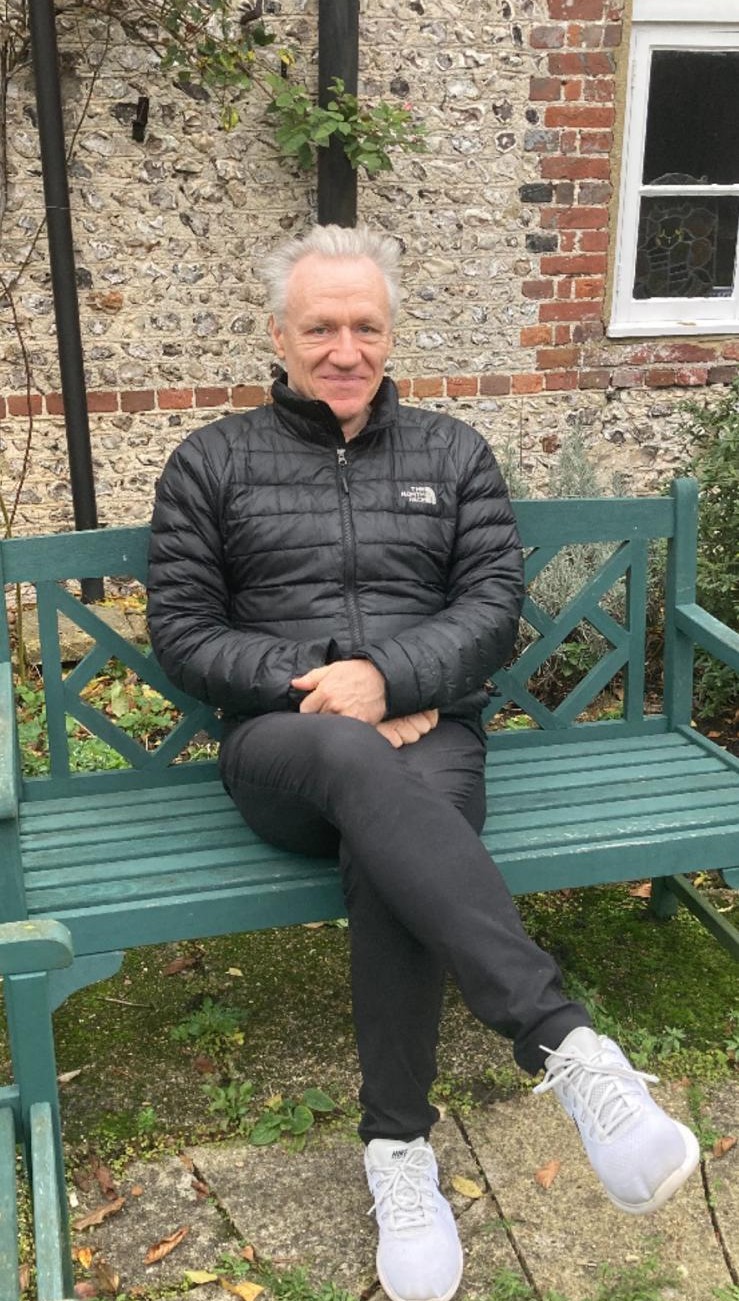
Our EMDR therapy is led by Richard Denny, an EMDR Europe accredited Clinical Consultant and Supervisor, an EMDR Europe accredited Practitioner, and an EMDR Association UK accredited Practitioner. Read Richard’s profile.
If trauma is part of your story, Richard will be involved in planning your care from the assessment onwards.
How the two fit together
The right mix depends on you, and we agree it at assessment:
EMDR on its own
For many people with PTSD, trauma-focused therapy is the recommended first step and may be all that’s needed.
Ketamine treatment with EMDR alongside
For people with treatment-resistant depression and a trauma history, EMDR can be planned around a course of ketamine sessions. Each ketamine session is followed by a one-hour integration session, where EMDR takes place. Preparation for EMDR starts at the end of the ketamine session itself, as the effects wear off.
Ketamine treatment with psychological support
For people where trauma isn’t the main issue, we still offer preparation and follow-up sessions with Richard. Before your first session, you talk through what to expect and what you hope to change. Afterwards, one-hour integration sessions help you make sense of the experience and turn it into practical changes in daily life. Your psychiatrist reviews your progress during and after the course.
Why combine them?
Researchers think ketamine may briefly make the brain more able to form new connections and update old memories, and that this could help trauma therapy work. Early studies are encouraging:
- In 2025, a review of the records of 8 people with PTSD treated with EMDR and low-dose ketamine at a private practice found their symptoms and day-to-day impairment dropped after four sessions.4
- A 2026 analysis pooling data from 533 people across 12 studies of ketamine combined with psychotherapy for PTSD found that people who had more therapy sessions tended to improve more.2
This research is at an early stage. Most of these studies were small or had no comparison group, and no large trial has yet compared EMDR plus ketamine with EMDR alone. We’ll be straight with you about that at assessment. For more on the evidence, read Is ketamine used to treat trauma and PTSD?
What does recent research show?
The strongest recent evidence is in treatment-resistant depression. A large 2023 trial found ketamine no less effective than ECT, and several trials found it improved symptoms more than an active comparison drug. Newer trials in PTSD and bipolar depression are also encouraging, but not every trial has been positive.
These studies build on smaller trials going back to 2006, which first showed that many people improved within 24 hours of a single infusion.19 A Cochrane review later rated the overall evidence from those early trials as very low certainty.15
Key studies since 2023
- 2026
Ket-BD trial, Canada (JAMA Psychiatry)1
Who took part: 68 adults with treatment-resistant bipolar depression, alongside their usual medication
What it found: Four infusions over two weeks lowered depression scores by 7.3 points more than the comparison drug (midazolam). No one developed mania or psychosis.
- 2025
Otago trial, New Zealand (BJPsych Open, a Royal College of Psychiatrists journal)3
Who took part: 33 adults with PTSD that hadn’t responded to standard treatment
What it found: A day after a single injection, 81% (higher dose) and 64% (lower dose) had at least halved their symptom scores, against 18% after the comparison drug (fentanyl). Some benefit remained a week later.
- 2025
KARMA-Dep 2, Ireland (JAMA Psychiatry)5
Who took part: 65 hospital inpatients with depression
What it found: Up to eight infusions made no clear difference compared with the comparison drug (midazolam).
- 2023
ELEKT-D, USA (New England Journal of Medicine)6
Who took part: 403 adults with treatment-resistant depression without psychosis
What it found: After three weeks, ketamine infusions were found to be no less effective than ECT. ECT was linked to more memory problems, and ketamine to more dissociation.
- 2023
KADS, Australia and New Zealand (British Journal of Psychiatry)7
Who took part: Adults with treatment-resistant depression
What it found: With doses adjusted to each person, 19.6% were in remission after four weeks of twice-weekly injections under the skin, against 2% on the comparison drug (midazolam).
What we don’t know yet
- How long it lasts. Improvement often fades within a week or two of the last session.11,18 The best way to keep it going is still being studied.
- Not every trial is positive. A 2025 trial in Ireland of up to eight infusions in hospital inpatients found no clear advantage over midazolam,5 a large 2022 US trial in military veterans found no clear effect on PTSD,14 and in a 2022 Swedish trial in inpatients, ECT led to more people recovering fully than ketamine.13
- Blinding is hard. Ketamine’s effects are easy to notice, so participants often know which treatment they had, which can inflate results.
- Long-term effects. Most studies follow people for weeks or months, not years.16
UK guidance
The Royal College of Psychiatrists says ketamine should be used only in specialist settings with proper oversight and long-term monitoring, with psychiatrists involved in leading services.11 NICE’s guideline on depression in adults doesn’t include ketamine infusions,9 and NICE hasn’t recommended esketamine nasal spray for NHS use.8
What does “off-label” mean?
Ketamine’s UK licence covers anaesthesia only.12 When a doctor prescribes a medicine for a use its licence doesn’t cover, it’s called off-label prescribing. This is legal and common in some areas of medicine, but it means the medicine hasn’t been through the licensing process for that use, and the prescribing doctor takes on more responsibility for the decision.
GMC guidance requires doctors to explain this to you, and to tell you about licensed alternatives, before you agree to treatment.
What are the side effects and risks?
During or shortly after a session
- dissociation and changes in perception
- feeling sick, sometimes vomiting
- dizziness or headache
- a temporary rise in blood pressure and heart rate
- anxiety, or a brief dip in short-term memory
These usually settle within a couple of hours.14 In one study of 684 infusions, rises in blood pressure were modest, peaked about 30 minutes in, and no infusion had to be stopped.17
Longer-term risks
Frequent, repeated or high doses of ketamine can damage the bladder (causing pain, frequent urination and blood in the urine) and the liver, and ketamine can be misused and cause dependence. These harms are mainly seen with heavy recreational use. They’re the reason treatment doses are measured, given under supervision and limited to a planned course.12,11
Ketamine is a controlled drug (Class B, Schedule 2), so it’s stored, prescribed and recorded under strict legal controls.
What happens after a course of treatment?
Benefits often fade, so we plan what happens next before you start.18 Some people have occasional top-up sessions, but the evidence on how best to do this is still limited.
Your psychiatrist reviews your progress twice during the course, then usually sees you every month or two for the three months afterwards. If it would help, further EMDR or top-up sessions can be arranged. If you want, we keep your GP informed.
How much does ketamine therapy cost?
Fees depend on the plan agreed at your assessment, so we send them to you when you get in touch.
- Health insurance
- We can’t accept insurance for EMDR or for the ketamine sessions. Some psychiatrist appointments may be covered, so check with your insurer.
- Cancellations
- Please give us at least 72 hours’ notice.
Treatment is only recommended if it’s clinically appropriate, never on the basis of price.
Your clinical team and our London clinic
- Dr Niraj Singh, consultant psychiatrist, or another consultant psychiatrist who works with us, assesses and prescribes.
- Richard Denny, EMDR Europe accredited Consultant, carries out the EMDR assessment, is with you during ketamine sessions and leads integration and EMDR.
- The partner clinic’s medical team gives the medicine and monitors you.
Our clinic is at 19 Elswick Street, London SW6 2QR. Open Monday to Friday, 9am to 5pm. We don’t take enquiries by phone, so please email us or use the enquiry form.
Frequently asked questions
No. Many people aren't suitable, for medical or psychological reasons, which is why everyone starts with a specialist assessment. If ketamine isn't right for you, we'll tell you why and what may help instead.
Yes. For many people with trauma symptoms, EMDR on its own is the recommended first step. It works best after an assessment, so we can plan the right approach with you.
Yes, when a doctor prescribes it. Ketamine is a controlled drug (Class B, Schedule 2). Doctors can prescribe it off-label for depression after an assessment and with your informed consent. Possessing or supplying it without a prescription is illegal.
Availability is very limited. A small number of specialist NHS services offer it. We can talk through NHS routes at your assessment.
Don't stop or change any medicine without medical advice. Your assessing doctor will review everything you take, because some medicines may interact with ketamine or affect how it works.
It varies, and any plan is set out after assessment. Our usual course is an introductory session, then six ketamine-assisted sessions of about two hours, each followed by a one-hour integration or EMDR session. We review your progress after every session.
No. After your first session, someone should collect you, or you should take a taxi. Your clinical team will advise about later sessions. Don't drive until your clinical team tells you it's safe to.
Ketamine can be misused and cause dependence, mainly with frequent, high-dose recreational use. In treatment, doses are measured, given under supervision and limited to a planned course, and current drug or alcohol misuse usually rules treatment out.
Possibly, but it needs extra care because of a risk of triggering mania. A 2026 trial in treatment-resistant bipolar depression found no cases of mania, but we decide case by case at assessment.
Usually not. Ketamine can bring back or worsen psychotic symptoms, so a history of psychosis or schizophrenia usually rules it out. We'll explain the other options at assessment.
Not everyone improves. We review your progress after every session and, if it isn't helping, stop and talk through other options with you.
Next step
Talk to us about an assessment
An assessment may or may not lead to a recommendation for ketamine. We’ll also discuss EMDR and other psychological therapy, medication options and NHS routes, and for some people another approach will suit them better.
If you’re in crisis now: ketamine treatment in a clinic is not a crisis treatment. If you’re having thoughts of ending your life, call 999 or go to A&E, call NHS 111 and choose the mental health option, or call Samaritans free on 116 123.
Confidential enquiry
Request a consultation
Tell us a little about you. A member of our clinical team will reply within 1–2 business days.
Confidential. We only use your details to respond to your enquiry.
Not for emergencies. If you’re in crisis now, call 999 or go to A&E, call NHS 111 and choose the mental health option, or call Samaritans free on 116 123.
References
Recent studies
- Orsini DK et al. (2026). JAMA Psychiatry. Ket-BD: serial ketamine infusions vs midazolam for treatment-resistant bipolar depression, 68 participants. doi.org/10.1001/jamapsychiatry.2026.2658
- Rohde J et al. (2026). Psychotherapy and Psychosomatics. Ketamine-assisted psychotherapy for PTSD: individual participant data meta-analysis, 12 studies, 533 participants. doi.org/10.1159/000553144
- Beaglehole B et al. (2025). BJPsych Open 11(6):e230. Ketamine vs fentanyl for treatment-resistant PTSD, randomised crossover, 33 participants. doi.org/10.1192/bjo.2025.10854
- Topel M, Ciccone D (2025). European Journal of Psychotraumatology 16(1):2572861. Ketamine-assisted EMDR for PTSD: chart review of 8 clients. doi.org/10.1080/20008066.2025.2572861
- Jelovac A et al. (2025). JAMA Psychiatry 82:1216–24. KARMA-Dep 2: up to eight infusions vs midazolam, Ireland. doi.org/10.1001/jamapsychiatry.2025.3019
- Anand A et al. (2023). New England Journal of Medicine 388:2315–25. ELEKT-D: ketamine vs ECT, 403 participants. doi.org/10.1056/NEJMoa2302399
- Loo C et al. (2023). British Journal of Psychiatry 223(6):533–41. KADS: four weeks of subcutaneous ketamine vs midazolam for treatment-resistant depression. doi.org/10.1192/bjp.2023.79
Guidance and earlier research
- NICE (2022a). Esketamine for treating treatment-resistant depression (TA854). nice.org.uk/guidance/ta854
- NICE (2022b). Depression in adults: treatment and management (NG222). nice.org.uk/guidance/ng222
- NICE (2018). Post-traumatic stress disorder (NG116). nice.org.uk/guidance/ng116
- Royal College of Psychiatrists (2025). Position statement PS02/25: Psychedelic and related substances (PARS) for medical use. rcpsych.ac.uk/docs/default-source/improving-care/better-mh-policy/position-statements/position-statement---ps02_25-pars-for-medical-use.pdf
- Ketalar (ketamine) injection: Summary of Product Characteristics (SmPC). Electronic Medicines Compendium. medicines.org.uk/emc/product/2231/smpc
- Ekstrand J et al. (2022). International Journal of Neuropsychopharmacology 25:339–49. KetECT: ketamine vs ECT in inpatients. doi.org/10.1093/ijnp/pyab088
- Abdallah CG et al. (2022). Neuropsychopharmacology 47:1574–81. Ketamine vs placebo for PTSD, 158 US service members and veterans. doi.org/10.1038/s41386-022-01266-9
- Dean RL et al. (2021). Cochrane Database of Systematic Reviews, CD011612. Review of ketamine and related medicines for depression. doi.org/10.1002/14651858.CD011612.pub3
- Short B et al. (2018). Lancet Psychiatry 5:65–78. Systematic review of side effects. doi.org/10.1016/S2215-0366(17)30272-9
- Riva-Posse P et al. (2018). Journal of Affective Disorders 236:291–7. Blood pressure across 684 infusions. doi.org/10.1016/j.jad.2018.02.025
- aan het Rot M et al. (2010). Biological Psychiatry 67:139–45. Relapse after a course of six infusions. doi.org/10.1016/j.biopsych.2009.08.038
- Zarate CA et al. (2006). Archives of General Psychiatry 63:856–64. Single infusion vs placebo, 18 participants. doi.org/10.1001/archpsyc.63.8.856